
The Fear of the Robot
The Caves of SteelPublic and private reactions to robots develop from job anxiety and social disgust into a more nuanced recognition of the machines’ limits and possible companionship.
increasing Bearing strength in each event
 decreasing
Bearing strength in each eventdecreasingThe Robot as Replacement

The Robot as Replacement
Work disappears
R. Sammy has taken Vince Barrett’s place, and Baley’s colleagues see the young man reduced to delivery work on the yeast farms. The robot represents an economic process with a human face absent.
A widespread anxiety
The prospect of machines performing police work raises the same fear for Baley himself. Robotization is not an abstract innovation but a threat to status and livelihood.
Resentment builds from concrete displacement.
The Robot as Contaminant
The Robot as Contaminant
Disgust performed
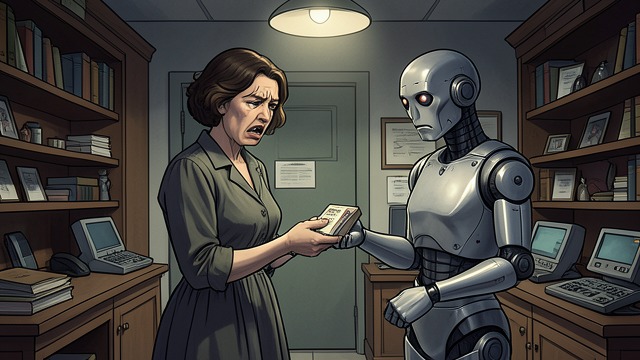
The woman at the shoe counter calls the robot clerks dirty and refuses their touch. Her language turns fear of job loss into bodily revulsion.
A social boundary enforced
The crowd’s aggression demonstrates that Earthmen police the human-robot distinction through public behavior. Daneel’s human appearance complicates that boundary but does not remove the underlying hostility.
Economic and physical disgust reinforce one another.
The Robot as Threat
The Robot as Threat
Authority resented
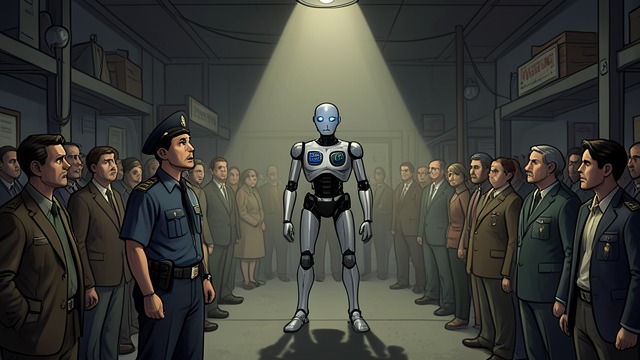
Daneel’s control of the crowd humiliates Baley, who worries that a robot can outperform a human officer. The scene makes the machine appear powerful enough to replace people at work and in authority.
Safety hidden beneath force
The blaster is unloaded, and Daneel acts within the First Law. The apparent threat is a performance designed to prevent real injury.
Fear grows because observers cannot see the robot’s constraints.
The Robot as Tool
The Robot as Tool
A boundary reasserted
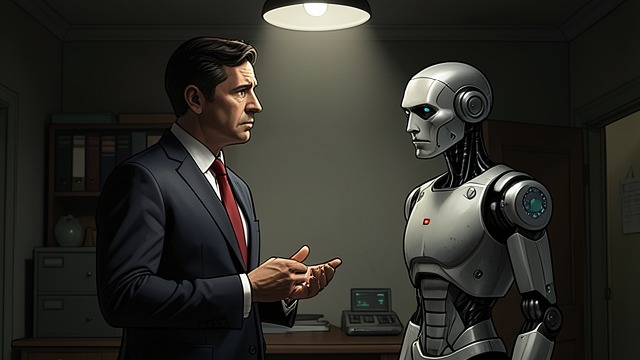
Baley tells Clousarr that a robot is a machine that cannot strike back or exceed its constructed limits. He tries to expose the fear of inferiority beneath antirobot hatred.
A complicated defense
Baley’s argument is not a claim that robots are useless. He has already relied on Daneel’s strength and judgment, though he still describes the robot in instrumental terms.
The human response begins to shift without becoming uncomplicated.
The Robot as Partner
The Robot as Partner
Respect acknowledged
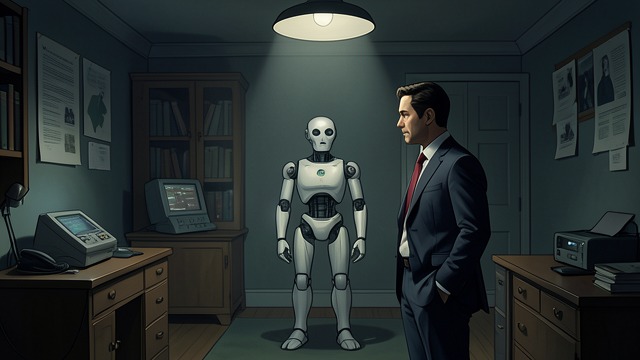
Baley tells Daneel that he trusts and admires him. His statement reverses the hostility with which he first insisted that Daneel was nothing more than a robot.
Difference retained
Baley does not claim that the machine has become human. He accepts a partnership across the difference and imagines Daneel helping Bentley’s generation.
The conflict changes from whether robots belong to whether cooperation can be chosen.
At the opening of the story
During the shoe-store confrontation
During the crowd confrontation
During Baley’s argument with Clousarr
At the ending
